
THE UNIQUE ECOLOGY OF LUFFENHAM HEATH GOLF CLUB
By JAMES HUTCHINSON
I guess the main aim and objective of this feature was to introduce you to some of the most interesting hawthorn trees I have ever had the pleasure to hug, from a safe distance obviously as they are quite thorny, hence the name. However, after visiting their home, a golf course in the more rural parts of Rutland, it appears the course and its history have an equally interesting story to be told.
Located in a SSSI (Site of Special Scientific Interest, more on this later) and Golf Environment Organisation Certified, Luffenham Heath Golf Club could be described as a heathland, acid heathland, calcareous grassland, dry lowland heath, a grassland developed on soils derived from the Jurassic Lower Lincolnshire Limestone and a grassland developed on soft limestones, so, with that in mind, it’s probably unique. In fact, it is unique.
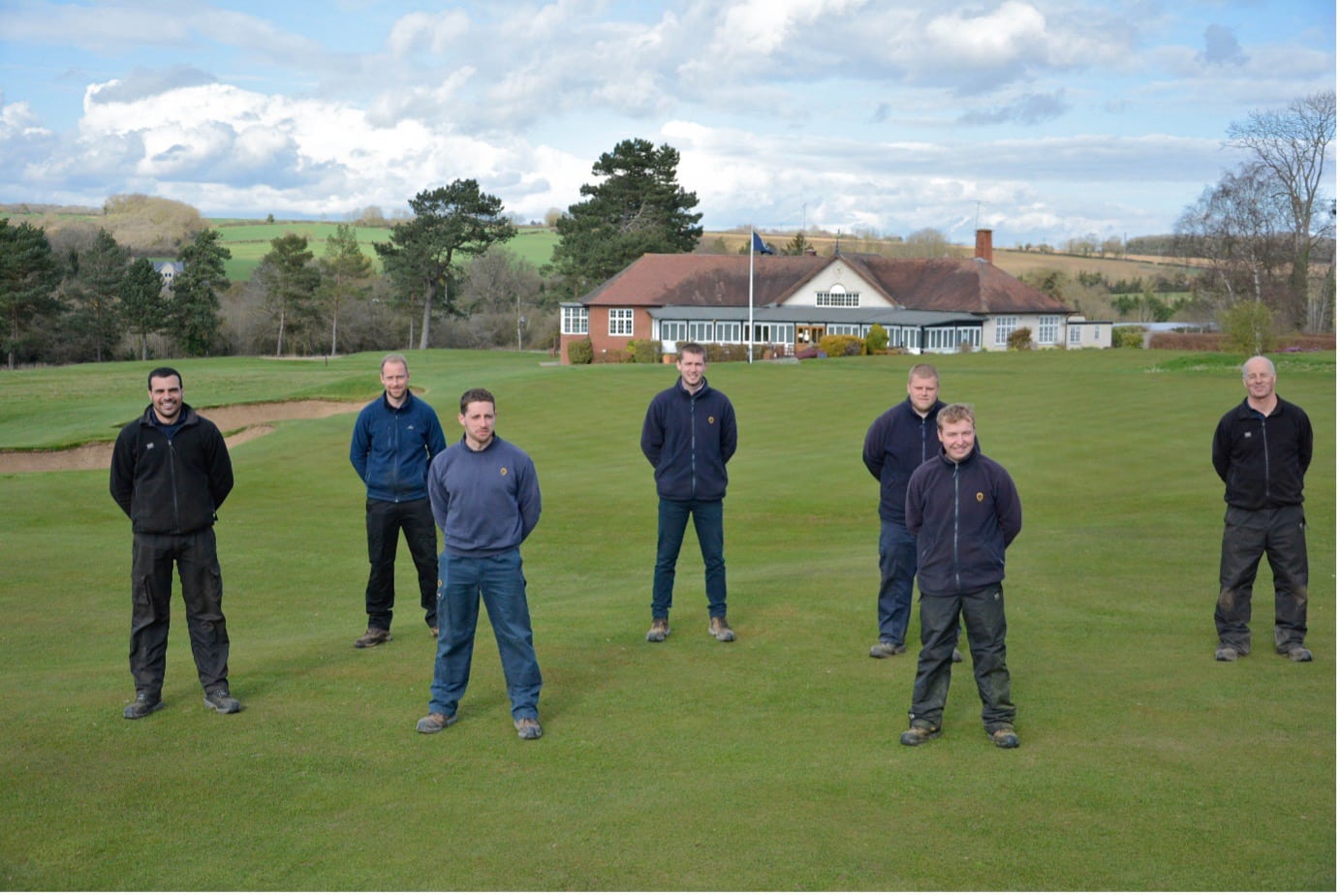
With 430 playing members and a healthy waiting list, the team are made up of 7 greenkeepers, a gardener and numerous volunteers. Jonny Peacock guides this excellent team of (from L to R shown in the pic) Ryan Jaffrey, Jonny Peacock, Ben Hodson, Adam Footitt, Trevor Shiells, Sam Ludlow and Jamie Goddard and appears to be heading in the right direction where agronomy is concerned.
Let’s start with the history – the club’s website is awash with interesting words such as these: In 1909, Lord Willoughby de Eresby first proposed the construction of a golf course on 250 acres of land known as South Luffenham Heath. At the time Sunday shooting was under threat and it was necessary to find diversionary entertainment for his visitors to nearby Normanton Lodge (the remains of which now overlook beautiful Rutland Water, formed by flooding the Gwash Valley in 1975). Local dignitaries supported the idea and, more importantly, so did his father Lord Ancaster on whose land the golf course was intended. Membership was to be encouraged and it was hoped to persuade the London & Great Eastern railway to halt at adjoining Fosters Bridge to allow golfers from Peterborough or Leicester to disembark. This request failed but, for a while, the course became an unscheduled stop with members climbing up or down the embankment on ladders. Members eventually had to travel by pony & trap from nearby railway stations.
The course was opened in 1911 with a celebrity match, witnessed by over 1000 spectators, between James Braid and Harry Vardon, both eventual winners of 5 Open Championships each. Vardon’s opening drive cleared the course boundary, the Morcott to Ketton road and landed in the adjoining field. Braid’s afternoon 72 remained a course record for many years and remains a very respectable score; indeed, given driving rain, a course measuring only a little less than 6000 yards and the equipment of the day. Braid eventually turned to course design and his appreciation of the course must have been sufficient to persuade him, between the two World Wars, to return and advise on changes that were needed.
Set in the Quorn and Cottesmore hunting country, it is hardly surprising that the Club attracted an aristocratic membership from far and wide. Viscount Castlereagh first became Captain in 1912 having been made Vice-President the previous year. He was again elected as club captain in1932, this time with the title Marques of Londonderry. The Castlereagh Cup for the Club Championship dates back to 1912 and is still contested for today, as a 36-hole scratch medal. In 1928 the Prince of Wales, later to become the uncrowned King Edward VIII, was invited by letter to St James’ Palace to become Captain; a position commemorated by the presentation of a trophy in 1929. The Prince of Wales Cup was requested by HRH to be contested annually, and that request was accepted and is contested to date as an 18 holes medal. Jonny mentioned “We hosted regional open qualifying for a number of years recently and we host the PGA pro-am annually, we are hoping to get more prestigious events again whether it be through the R&A or England Golf” – I’m pretty sure you’ll get them, Jonny.
With many types of butterfly now emerging onsite such as the black hairstreak (quite rare), how would you go about managing the fragile mosaic of grasslands which make up this beautiful golf course. Well Jonny Peacock is the man to ask, and so I did. Jonny’s response was one that you would expect from such a proactive Course Manager: “All areas of long and out of play rough are cut and collected every other year so as to holistically thin-out the undesirable grasses. Fringing rough and carry’s are scarified and cut and collected yearly for the same reason. We physically remove weeds or carefully spot spray with a knapsack if needed. We also manage the course with low chemical inputs mainly just using seaweeds and wetting agents trying to encourage as many fine grasses as possible.” Thanks Mr P, sounds like you’re heading down the correct route for the site. It may be that some really interesting flora and fauna begin to emerge soon.
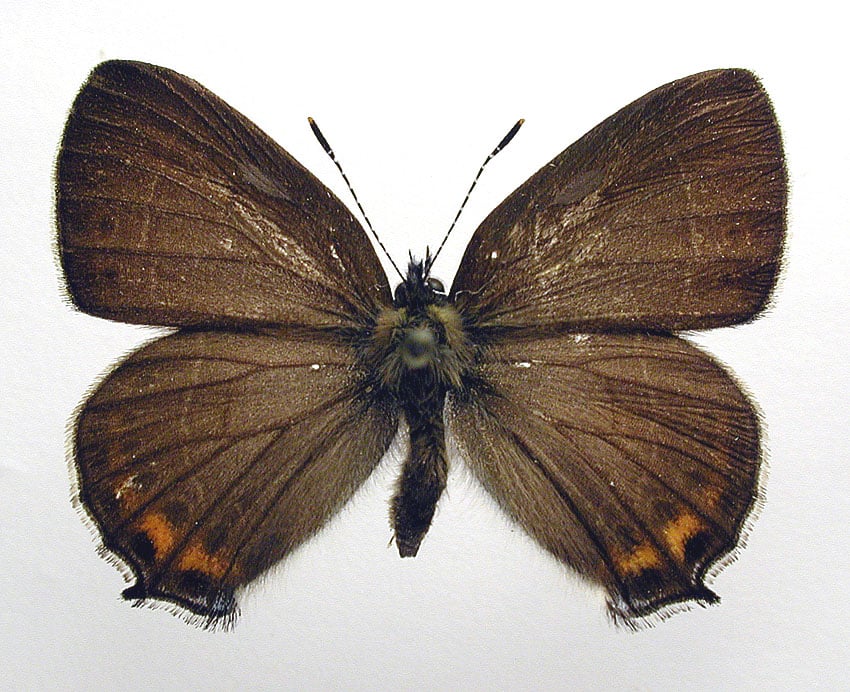
Speaking of interesting fauna, it is known that the black hairstreak is one of our most elusive and rare butterflies, however, it can be seen on the golf course, if you know what you are looking for, that is. This particular butterfly is often misidentified as being a white-letter hairstreak or a purple hairstreak. It is found only in thickets of thorny woodlands between Oxford and Peterborough in the East Midlands of England. Jonny and the team are aware of this rarity and manage the thorn shrubs correctly i.e., on a rotational basis with advice from the STRI’s eco department who developed a 5-year rolling plan for the course. Luffenham also work closely with Natural England and take guidance on any fragile woodland management work, Jonny alludes “we also have local wildlife groups that keep records of wildlife on the course”. The Wildlife Trust offers further advice on this beautiful butterfly and its life: “Caterpillars go through a serious of moults, called ‘instars’, before they mature, often looking quite different each time. The older caterpillars of the black hairstreak bear a striking resemblance to the blackthorn leaves on which they feed – a great form of camouflage.” If anyone knows butterflies, it’s the Wildlife Trust!
Still on the subject of wildlife, Luffenham’s website has a page dedicated to sightings with excellent photographs taken by David Cotter, Rutland Natural History Society. You get the feeling that this is one of those courses where you have no idea what will show up next, they’re the best kind.
Now then, all the aforementioned words have been bringing us slowly back around to the beginning of this feature, which was hawthorn trees of historical importance. As it so happens, there are only a handful of 2 metre girthed hawthorn trees growing here in the UK and do you know what? A quick search of the course revealed at least 5 which are of, or over, this size making them true oldies of the woodland world. In fact, one of the trees is approaching 2.8 meters and, at this time, I am aware of only 1 that is of this size anywhere in Europe! The Woodland Trust’s, Ancient Tree Inventory have remotely assessed the trees and awarded them veteran status on their interactive map.
A search of the interweb gave me further insight into the world of hawthorn trees, and in particular, ancient hawthorn trees. In fact, one of the UK’s smallest nature reserves (Hethel Old Thorn) consists of one ancient hawthorn tree, that’s it, just one tree! It is a 0.025-hectare (0.062-acre) nature reserve south-west of Norwich in Norfolk and consists of one tree. You are reading it correct – the whole nature reserve is one tree. Anyway, the eponymous thorn itself is thought to be one of the most ancient hawthorns in England, possibly dating from the 13th century. In 1755 its girth was recorded as 9 feet 1 inch (approximately 2.8 metres and around the size of Luffenham’s largest I recorded), but it has now decayed to a remnant of its former self. Even so, there is still something very appealing about this venerable shrub, which continues to grow each year and remains healthy. Superstition has it that the hawthorn grew from the staff of Joseph of Arimathea – a folk tale associated with other thorns around the country including at Glastonbury.
If paganism is your thing, then you may be interested to know that hawthorn is a pagan symbol of fertility and has ancient associations with May Day. It was the ancestor of the Maypole and its leaves and flowers the source of May Day garlands as well as appearing in the wreath of the Green Man. Although, if paganism is your thing then you probably knew that anyway – an interesting fact, nonetheless.
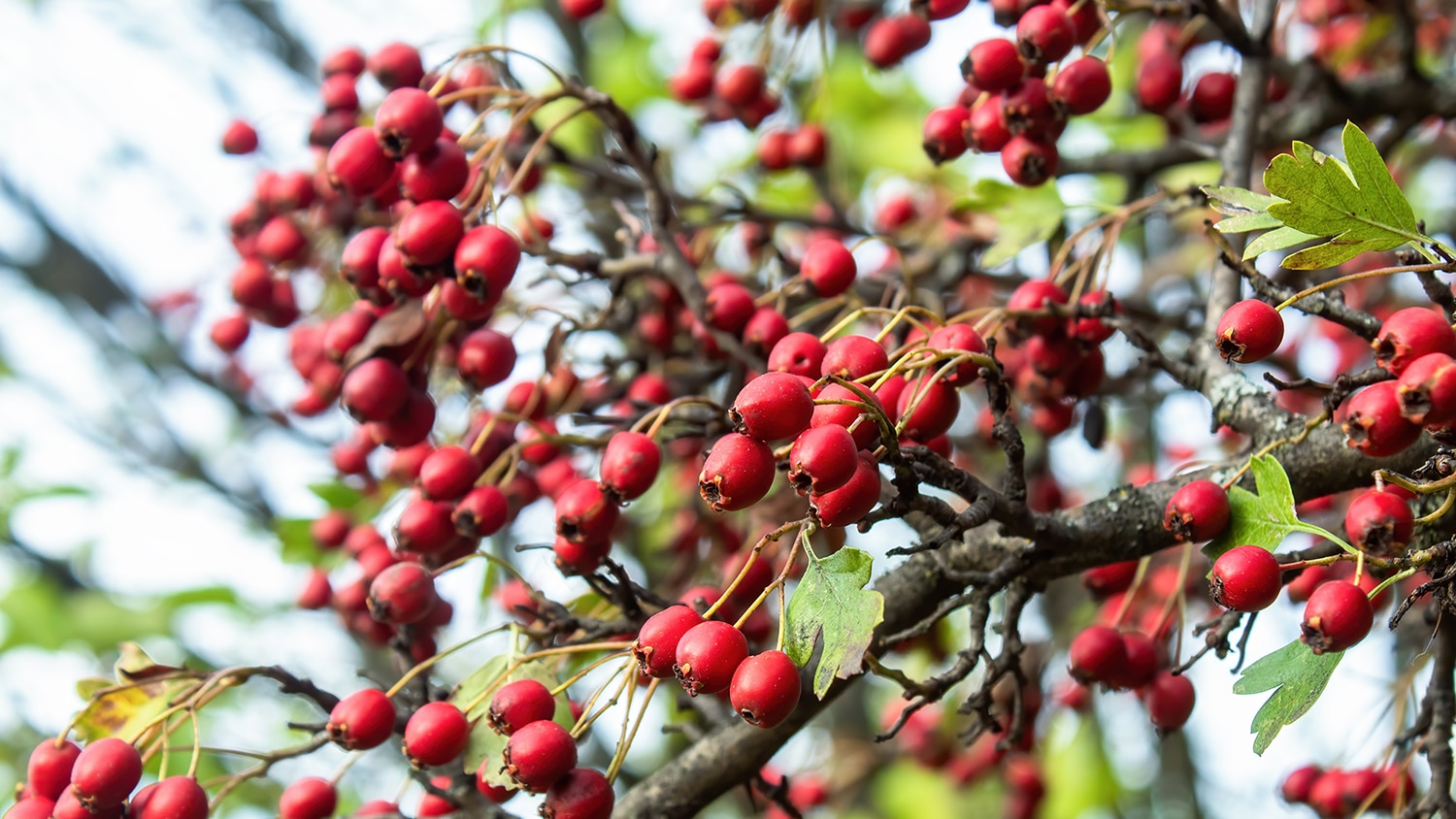
In terms of wildlife attraction, look no further then planting hawthorn trees on your golf course as there has been a minimum of 300 different types of insect recorded on these thorny beauties. Many moth types are attracted to the tree and I never get tired of reading – up on moths given the amusing names they have such as pear leaf blister, dwarf cream wave, rhomboid totrix and the fruitlet-mining totrix all of which can be found mooching around old hawthorn trees. Actually, still on the subject of moths, Luffenham Heath GC have been involved in recording moths onsite and since 2010, 642 types have been recorded by the local wildlife trust. Now that’s impressive by any area’s standards.
So back to the SSSI thing. This acronym strikes fear into the hearts of most greenkeepers as this now means you cannot do what you want to do on your golf course. However, it needn’t be that way and it may be that you can apply for an environmental stewardship scheme – this where you are paid to manage the sensitive areas of your course in a certain way. If you are unsure as to whether you have a protected area on your site, then Google ‘DEFRA’s Magic Map Application’ and you will find an overhead view of the UK. Once in to the map, simply type in your postcode into the search engine and the map will centre over that location. It is then a case of ticking the relevant box to see if you have a SSSI, SAC (Special Area of Conservation) and so on. If BIGGA members are uncertain about any of this then send me an email and I may be able to assist further; SSSI means Site of Special Scientific Interest by the way. The reasons for Luffenham Heath GC’s SSSI is: The site includes some of the best remaining areas of calcareous grassland in Leicestershire and is representative of grassland developed on soft limestones in Central and Eastern England – Natural England’s words and who could argue with that.
With all the aforementioned words considered, and having seen the site at first hand, I am quite happy to suggest Luffenham Heath is one of the finest courses you will find. I often visit sites which have excellent woodlands or grasslands, or maybe beautiful birdlife milling around the playing surfaces, however, I rarely visit one that has them all. Luffenham Heath is unquestionably up there with the best!
James Hutchinson.
James Hutchinson worked for BIGGA as an ecology adviser before becoming a freelance writer, ecologist and consultant. He can be contacted at jameshutchinson38@googlemail.com

